Tuesday, April 04, 2017

Introduction to Question Reality
!
MARCELO GLEISER:
Welcome to Question Reality. My name is Marcello Gleiser, and I will
be your instructor f
or this
very unique and exciting course based on my book, The Island of
Knowledge. For the next
few weeks, we'll dive deep into some of the most fundamental
questions in science and
philosophy, questions that have occupied the minds of some of the
greatest
thinkers of all
ages.
How do we know what is real? What is the world made of? What is
the Big Bang? Who are we
in this vast expanding universe? How much can we know of the
world and ourselves? How can
we find meaning when we are surrounded by so much doub
t and
mystery?
The course is divided into three main segments
--
cosmos, matter and mind. In all three, we'll
examine some of the most challenging questions in science and philosophy following a
historical
approach. We start with the first ideas on the topi
c and move forward to the frontiers
of current
knowledge.
In cosmos, we'll trace the evolution of our changing world views from the Greeks to
the Big
Bang and the multiverse. In matter, we start in ancient Greece and explore how the
concept of
atom evolved into modern quantum mechanics and the search for the fundamental
building
blocks of matter at CERN. In mind, we examine the nature of mathematics and
computers,
exploring their connection to the greatest mystery of all, our own consciousness.
After an introduction to these topics through brief video lectures and reading short blog posts,
we
will help you discuss with your classmates the nature of reality and knowledge about the
world
around us. We'll ask for your opinions and viewpoints as well
as reflections on how your
own
knowledge is changing. You'll go out into your community of friends, family and
colleagues to
find out their ideas on some of the course topics. We'll schedule live events
where you can "Ask
Marcello Anything" about reality,
philosophy and science. We can't wait to
start this adventure
into reality with all of you.
If you think you know what reality is, think again.
For example, here you have a cloud chamber
where you can see the tiny tracks cutting through
the suspended mist
. These tracks are
actually subatomic particles raining from the skies and from
underground. Without the right
tool, you wouldn't know they existed. But here they are, part of
our physical reality.
As Antoine
de Saint Exupery said in his classic book, The
Little Prince, "what is essential is
invisible to the
eye." In this course, we'll learn to look beyond appearances as we explore the
deepest
aspects of reality.

Does The Multiverse Make Sense? : 13.7: Cosmos And Culture : NPR

Does The Multiverse Make Sense? : 13.7: Cosmos And Culture : NPR

Tuesday, March 29, 2016

“What a strange thing! To be alive beneath cherry blossoms.” - Kobayashi Issa

Monday, December 07, 2015

8 Great Philosophical Questions That We'll Never Solve

8 Great Philosophical Questions That We'll Never Solve

 Philosophy goes where hard science can't, or won't.
Philosophers have a license to speculate about everything from
metaphysics to morality, and this means they can shed light on some of
the basic questions of existence. The bad news? These are questions that
may always lay just beyond the limits of our comprehension.


Here are eight mysteries of philosophy that we'll probably never resolve.

1. Why is there something rather than nothing?

 2. Is our universe real?

 3. Do we have free will?

 4. Does God exist?

 5. Is there life after death?

6. Can you really experience anything objectively?

 7. What is the best moral system?

 8. What are numbers?


Thursday, October 08, 2015

Our Favorite Pictures From the Apollo Mission Photo Dump

Our Favorite Pictures From the Apollo Mission Photo Dump


With one small link and one giant leap in photo quality, a space
enthusiast  has rocketed to Internet renown, creating a Flickr account
full of high-definition, unprocessed photos from the Apollo moon
missions.


The more than 10,000 photos in the collection have been in the public
domain for decades, but NASA has never made high-definition scans of
the images accessible in one place online. That’s where Kipp Teague
comes in. Teague is a private citizen and lifelong follower of NASA who
runs the Project Apollo Archive, a website devoted to all things moon mission.

Monday, September 28, 2015

Salty water seen flowing on Mars, not far from Curiosity rover | New Scientist

Salty water seen flowing on Mars, not far from Curiosity rover | New Scientist


Salty water seen flowing on Mars, not far from Curiosity rover


Salty water seen flowing on Mars, not far from Curiosity rover

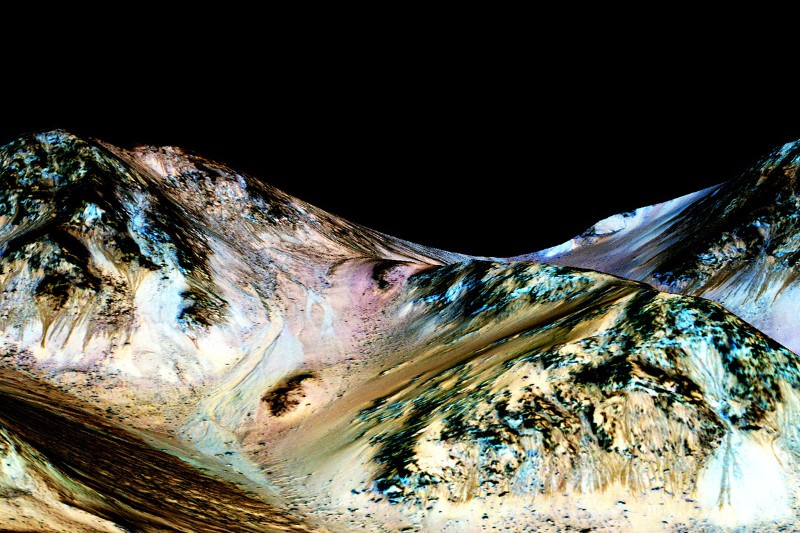
The dark streaks in this picture may be signs of salty water (Image: JPL/NASA)


NASA’s Mars Reconnaissance Orbiter has captured the strongest
evidence yet that salty liquid water flows on the planet’s surface
during warm seasons.


Whether or not these salty flows could sustain life depends on how salty they are, says Lujendra Ojha
of the Georgia Institute of Technology in Atlanta, who has reported the
findings, along with his colleagues. “If the water is completely
saturated with perchlorates [hydrated salts], then life as we know it on
Earth wouldn’t be able to survive in that sort of concentrated water,”
he says. “But if the water only has a tiny percentage of perchlorates in
it, then I think we should be fine.


Recurring slope lineae – dark streaks that appear, get longer, and fade in each Martian year – have long been thought to represent signs of flowing water. Now that idea has been backed up by data from the Orbiter’s onboard spectrometer, named CRISM, which analyses reflected sunlight to detect patterns that indicate what minerals are present on the surface.


Salts can absorb water from the atmosphere and lower the freezing
point of water, making it possible for liquid water to exist even in the
cold Martian climate. Spectral data from four locations with recurrent
slope lineae reveal the presence of hydrated salts, which are most
likely to be magnesium perchlorate, magnesium chlorate and sodium
perchlorate.

Saturday, September 26, 2015

NASA to Announce Mars Mystery Solved | NASA

NASA to Announce Mars Mystery Solved | NASA

 NASA will detail a major science finding from the agency’s ongoing
exploration of Mars during a news briefing at 11:30 a.m. EDT on Monday,
Sept. 28 at the James Webb Auditorium at NASA Headquarters in
Washington. The event will be broadcast live on NASA Television and the
agency's website.

Wednesday, August 26, 2015

Abraham Loeb: From cosmic origins to our galaxy’s fate | Astronomy.com

Abraham Loeb: From cosmic origins to our galaxy’s fate | Astronomy.com

 This theoretical physicist and philosophical thinker discusses
diversity, the first stars, the future of cosmology, the way physics
makes progress, and more.

Friday, July 24, 2015

Earth-like alien world looms into view through Kepler telescope - New Scientist

Earth-like alien world looms into view through Kepler telescope - New Scientist


Meet Kepler 452b, Earth’s new alien cousin. This rocky planet is the first alien world we’ve seen that circles a sun-like star at a distance that should allow liquid water to exist on its surface.


The planet came to light after a first pass through the full data set
collected during the NASA Kepler telescope’s four-year run. The
analysis also yielded about a dozen other candidate worlds close to the
size of Earth in the habitable zone around their stars.


Kepler’s original mission has ended,
so the new discoveries come not from new data but from
ever-more-thorough analyses of the existing data. Small Earth-like
planets have proved the hardest to tease out. “We’re treading through
the weeds looking for these tiny stones,” says Natalie Batalha from the NASA Ames Research Center in California.


The new search adds more than 500 planets to the roughly 4000 planet candidates the Kepler team has already announced, of which about a quarter of have already been confirmed through follow-up studies.


But the newest confirmed planet, 452b, is in an Earth-like class by
itself. “Today the Earth is a little less lonely, because there’s a new
kid on the block,” says Jon Jenkins,
also at NASA Ames. The new planet was confirmed when team members
calculated that there was a less than 1 per cent chance that a pair of
eclipsing binaries or a background transiting planet could be polluting
the signal.

Monday, June 01, 2015

Origins of Life On Earth & Beyond --"From Matter to Living Biology" (Weekend Feature)

Origins of Life On Earth & Beyond --"From Matter to Living Biology" (Weekend Feature)

 Such primitive cells, or protocells (iamge below), would have been much
simpler than any of today's modern cells, which have an organization
based upon the "central dogma" of biology: DNA, containing a cell's
genetic blueprint in a string of the nucleotide bases A, T, G, and C, is
transcribed into RNA, and then factories called ribosomes translate the
RNA into the sequences of twenty amino acids that make up proteins.
These proteins run almost all of the operations of cells, from bacteria
to humans: moving, metabolizing food, disposing of waste, speeding up
and slowing down the chemical reactions that copy our genes...............


Tuesday, May 19, 2015

Seeing Eye to Microscopic Eye | PROOF

Seeing Eye to Microscopic Eye | PROOF

 The eye is an organ of extreme perfection. I have a strong interest in
evolution, and eyes have developed stunning adaptations over time. This
mayfly (above) is a male with what are called turban eyes—greatly
enlarged eyes at the top of the head in the shape of a turban. The male
uses his eyes to scout for the silhouette of a female in the dim light
of dusk. He doesn’t even have a working mouth. If you live for only one
day, as adult males usually do, you don’t need to eat. But you do need
tremendous eyes to find a female before you die.

Friday, May 15, 2015

Science's Path from Myth to Multiverse - Scientific American

Science's Path from Myth to Multiverse - Scientific American


It’s
sometimes said that supersymmetry would be a kind of thumbs-up for
string theory, which has been impossible to test in any direct way. If
the LHC finds no evidence for supersymmetry, what happens to string
theory?


Damned if I know! Unfortunately, string theory doesn’t make very
specific predictions about physics at the energies that are accessible
to us. The kind of energies of the structures that string theory deals
with are so high, we’ll probably never be able to reproduce them in the
lab. But those energies were common in the very early universe. So by
making cosmological observations, we may get a handle on the physics of
those incredibly high energies. For example, if the matter-energy
density at the time of inflation was
of the order of magnitude that is characteristic of string theory, then
a great deal of gravitational radiation would have been produced at
that time, and it would have left an imprint on the cosmic microwave
background. Last year, scientists working with the BICEP2 telescope announced that they had found these gravitational waves; now it seems they were actually measuring interstellar dust. Further observations with the Planck satellite
may be able to settle this question. I think that’s one of the most
exciting things going on in all of physical science right now.


For theorists, is the ultimate goal a set of equations we could put on a T-shirt?

That’s the aim. The Standard Model is so complex that it would be hard
to put it on a T-shirt—though not impossible; you’d just have to write
kind of small. Now, it wouldn’t take gravity into account, so it
wouldn’t be a “theory of everything.” But it would be a theory of all
the other things we study in our physics laboratories. The Standard
Model is sufficiently complicated, and has so many arbitrary features,
that we know it’s not the final answer. The goal would be to have a much
simpler theory with fewer arbitrary features—maybe even none at
all—that would fit on a T-shirt. We’re not there yet.

Some physicists suggest that we may have to settle for an
array of different theories, perhaps representing different solutions
to string theory’s equations. Maybe each solution represents a different
universe—part of some larger “multiverse.”


I am not a proponent of the idea that our Big Bang universe is just part
of a larger multiverse. It has to be taken seriously as a possibility,
though. And it does lead to interesting consequences. For example, it
would explain why some constants of nature, particularly the dark energy,
have values that seem to be very favorable to the appearance of life.
Suppose you have a multiverse in which constants like dark energy vary
from one big bang to another. Then, if you ask why it takes the value it
does in our Big Bang, you have to take into account that there’s a
selection effect: It’s only in big bangs where the dark energy takes a
value favorable to the appearance of life that there’s anybody around to
ask the question.


This is very closely analogous to a question that astronomers have
discussed for thousands of years, concerning the Earth and the sun. Why
is the sun the distance that it is from us? If it were closer, the Earth
would be too hot to harbor life; if it were further away, the Earth
would be too cold. Why is it at just the right distance? Most people,
like Galen, the Roman physician, thought that it was due to the
benevolence of the gods, that it was all arranged for our benefit. A
much better answer—the answer we would give today—is that there are
billions of planets in our galaxy, and billions of galaxies in the
universe. And it’s not surprising that a few of them, out of all those
billions, are positioned in a way that’s favorable for life.


But at least we can see some of those other planets.
That’s not the case with the universes that are said to make up the
multiverse.


It’s not part of the requirement of a successful physical theory that
everything it describes be observable, or that all possible predictions
of the theory be verifiable. For example, we have a very successful
theory of the strong nuclear forces, called quantum chromodynamics
[QCD], which is based on the idea that quarks are bound together by
forces that increase with distance, so that we will never, even in
principle, be able to observe a quark in isolation. All we can observe
are other successful predictions of QCD. We can’t actually detect
quarks, but it doesn’t matter; we know QCD is correct, because it makes
predictions that we can verify.


Similarly, string theory, which predicts a multiverse, can’t be
verified by detecting the other parts of the multiverse. But it might
make other predictions that can be verified. For example, it may say
that in all of the big bangs within the multiverse, certain things will
always be true, and those things may be verifiable. It may say that
certain symmetries will always be observed, or that they’ll always be
broken according to a certain pattern that we can observe. If it made
enough predictions like that, then we would say that string theory is
correct. And if the theory predicted a multiverse, then we’d say that
that’s correct too. You don’t have to verify every prediction to know
that a theory is correct.


When we talk about the multiverse, it seems as though
physics is brushing up against philosophy. A number of physicists,
including Stephen Hawking and Lawrence Krauss, have angered philosophers
by describing philosophy as useless. In your new book, it sounds as if
you agree with them. Is that right?


I think academic philosophy is helpful only in a negative sense—that is,
sometimes physicists get impressed with philosophical ideas, so that it
can be helpful to hear from experts that those ideas have been
challenged within the philosophical community. One example is positivism,
which decrees that you should only talk about things that are directly
detectable or observable. I think philosophers themselves have
challenged that, and it’s good to know that.


On the other hand, a kind of philosophical discussion does go on
among physicists themselves. For example, the discussion we were having
earlier about the multiverse raised the issue of what we expect from a
scientific theory—when do we reject it as being outside of science; when
do we accept it as being confirmed. Those are meta-scientific
questions; they’re philosophical questions. The scientists never seem to
reach an agreement about those things—like in the case of the
multiverse—but then, neither do the professional philosophers.


And sometimes, as with the example of positivism, the work of
professional philosophers actually stands in the way of progress. That’s
also the case with the approach known as constructivism—the idea that
every society’s scientific theories are a social construct, like its
political institutions, and have to be understood as coming out of a
particular cultural milieu. I don’t know whether you’d call it a
philosophical theory or a historical theory, but at any rate, I think
that view is wrong, and I also think it could impede the work of
science, because it takes away one of science’s great motivations, which
is to discover something that, in an absolute sense, divorced from any
cultural milieu, is actually true.


You’re 81. Many people would be thinking about retirement, but you’re very active. What are you working on now?

There’s something I’ve been working on for more than a year—maybe it’s
just an old man’s obsession, but I’m trying to find an approach to
quantum mechanics that makes more sense than existing approaches. I’ve
just finished editing the second edition of my book, Lectures on Quantum Mechanics,
in which I think I strengthen the argument that none of the existing
interpretations of quantum mechanics are entirely satisfactory.


I don’t intend to retire, because I enjoy doing what I’m doing. I
enjoy teaching; I enjoy following research; and I enjoy doing a little
research on my own. The year before last, before I got onto this quantum
mechanics kick, I was writing papers about down-to-earth problems in
elementary particle theory; I was also working on cosmology. I hope I go
back to that.


Comments

Wednesday, May 06, 2015

Sign in to read: The human universe: Could we become gods? - life - 05 May 2015 - New Scientist

The human universe: Could we become gods? - life - 05 May 2015 - New Scientist

 ما گونه یی کنجکاو بوده و این کنجکاوی ما را به ایده‌های جالبی‌ در مورد
جایگاهمان در جهان : خدا، تکامل، هوشیاری کوانتومی و چند جهانی‌
میرساند.این جهان واقعی‌ نیست و ما در درون یک شبیه سازی کامپیوتری که توسط
هوش برتر ایجاد شده زندگی‌ می‌کنیم.و اگر چنین باشد آیا ما خود خواهیم
توانست آفریننده یک جهان باشیم ؟ خلق هوش مصنوعی اولین پیش نیاز رسیدن به
چنین مقصدی است ......


The human universe: Could we become gods?

We are a curious species, and our curiosity has led to some interesting ideas about our place in the universe: gods, evolution, quantum consciousness and the multiverse.

But perhaps the most curious of all is the idea that the universe isn't real, and we live in a computer simulation
created by a superior intelligence. In fact, according to Nick Bostrom,
the philosopher who developed the idea, this is the most likely
explanation for our existence.

Whatever the plausibility of this
claim, it begs a tantalising question: could we ever create such a
simulation? Could we become the gods of an artificial universe inhabited
by creatures so smart they are able to question their own place in
their universe?

The first requirement would be to create
artificial intelligence that can carry out the same range of
intellectual tasks as a human. According to cognitive roboticist Murray
...

Wednesday, April 29, 2015

Journey to Mars Overview | NASA

Journey to Mars Overview | NASA


NASA is developing the capabilities needed to send humans to an
asteroid by 2025 and Mars in the 2030s – goals outlined in the
bipartisan NASA Authorization Act of 2010 and in the U.S. National Space
Policy, also issued in 2010.


Mars is a rich destination for scientific discovery and robotic and
human exploration as we expand our presence into the solar system. Its
formation and evolution are comparable to Earth, helping us learn more
about our own planet’s history and future. Mars had conditions suitable
for life in its past. Future exploration could uncover evidence of life,
answering one of the fundamental mysteries of the cosmos: Does life
exist beyond Earth?


While robotic explorers have studied Mars for more than 40 years,
NASA’s path for the human exploration of Mars begins in low-Earth orbit
aboard the International Space Station. Astronauts on the orbiting
laboratory are helping us prove many of the technologies and
communications systems needed for human missions to deep space,
including Mars. The space station also advances our understanding of how
the body changes in space and how to protect astronaut health.

Monday, April 13, 2015

The Milky Way's Globular Star Clusters --"Relics from the Early Universe"

The Milky Way's Globular Star Clusters --"Relics from the Early Universe"

 Observations of globular clusters' stars reveal that they originated
around the same time — more than 10 billion years ago — and from the
same cloud of gas. As this formative period was just a few billion years
after the Big Bang, nearly all of the gas on hand was the simplest,
lightest and most common in the cosmos: hydrogen, along with some helium
and much smaller amounts of heavier chemical elements such as oxygen
and nitrogen.

Sunday, January 25, 2015

Wednesday, August 13, 2014

یاسها منتظرند

 باد  و باران و گیاهی که تویی بر لب جوی
 همه از کوچه ها مرا می خوانند
 من از این باران ها می دانم خانه ویران خواهد شد
 ویران
یاس ها ریخته اند
زیر باران ها در کوچه رها
مثل مرداب بزرگی که در آن نیمه ی شب ها تنها
غوک ها می خوانند
و تو تنها می مانی
تا بدانی که چه ها می گذرد
من از این پنجره واری که سیاهست و بلند
 به صدای تو که جاری خواهی شد
 که مرا تنها در کوچه رها خواهی کرد
 به صدای تو رها می شوم از شاخه ی خویش
زیر باران ها در کوچه سنگی
ویران خواهم شد
زیر این پنجره واری که تماشا گه باد است و گیاهی تاریک
 به جهان گذران می نگرم
 بادها در گذرند
 یاسها منتظرند
 جوی گریانی و در بارانها می گذری
تا می مانی و باران غریبی که زمین را
 ویران خواهد کرد
 آسمانی که به ما می نگریست
 ماهتابی که به مه میتابید
همه در تاریکی ها ماندند
 همه در باران فریاد زنان می گفتند
 یاسها منتظرند
و تو گریان می گفتی : یاسها ریخته اند
باد و باران و تماشای گیاهی که مرا می بیند
 من ازین پنجره واری که سیاهست و بلند
 به تو فریادزنان می گویم
یاس ها منتظرند
 و تو گریانی و در باران ها می گذری
خانه ویران خواهد شد
 ویران
 و گیاهی که تویی بر لب جوی
 ریشه در آب روان خواهد شست
 یاسها منتظرند
من همینجا تنها خواهم ماند 
 M.Azad

Friday, May 30, 2014

SpaceX unveils sleek, reusable Dragon crew capsule - space - 30 May 2014 - New Scientist

SpaceX unveils sleek, reusable Dragon crew capsule - space - 30 May 2014 - New Scientist


First cargo, now crew – the uber-modern "space taxi"
known as the Dragon V2 is ready for passengers. At an unveiling ceremony
yesterday, complete with smoke effects and coloured lights, SpaceX CEO
Elon Musk gave the world its first glimpse of the upgraded Dragon
spacecraft.
NASA is already using an unpiloted version of Dragon to send cargo to the International Space Station and return valuable gear and scientific experiments. But Musk has always wanted Dragon to become a reusable ride for astronauts.
The new vehicle has simple silvery walls,
seats for up to seven passengers and a set of flatscreen control panels.
The spacecraft can dock itself to the ISS without help from the space station's robotic arm. But the most radical aspect of the redesign is the landing gear, which will allow astronauts to set the spacecraft down on solid ground.

Space chopper

The current version of Dragon deploys a
parachute as it descends and splashes down in the ocean. Dragon V2
instead comes with a set of incredibly powerful SuperDraco engines,
each capable of producing more than 70,000 newtons of thrust. The
engines will allow astronauts to better manoeuvre in space as well as
control their trajectory for re-entry.


"You'll be able to land anywhere on Earth with the
accuracy of a helicopter," Musk said during the event at SpaceX
headquarters in Hawthorne, California. The engines are encased in
protective shells, and they are set up in pairs so that if one fails,
the other can give a boost of power to compensate.

Friday, April 04, 2014

Buried 'Lake Superior' seen on Saturn's moon Enceladus - space - 03 April 2014 - New Scientist

Buried 'Lake Superior' seen on Saturn's moon Enceladus - space - 03 April 2014 - New Scientist

They found that Enceladus has a rocky core and an icy
crust. "Before, we knew almost nothing about the core beyond its likely
existence. Now we know roughly how big it is, and also that it has a
surprisingly low density," says team member Francis Nimmo
at the University of California, Santa Cruz. "That might be due to open
fractures, or low-density hydrated minerals like clays. Either answer
suggests that the rock has been in substantial contact with water, for
instance allowing minerals to dissolve, and explaining the salty ice
grains we see coming out of the surface."
The team also found that the southern
hemisphere has a stronger gravitational pull than its topography would
suggest. That could be explained by a localised sea, sitting beneath 35
kilometres of ice and up to 8 kilometres deep. It would contain about as
much water as Lake Superior in North America.


Destination, Enceladus?

If there might be life there, when can we go?
Cassini winds down in three years and there are no firm plans for
future craft to return to Saturn. However, Cassini team member Carolyn Porco at the Space Science Institute in Boulder, Colorado, has written a paper (soon to appear in the journal Astrobiology)
arguing for a mission to collect samples from Enceladus and return them
to Earth. She says the new results bode well for such an effort. "The
next mission there can immediately get down to the business of searching
for signs of life or its precursor chemistry. It's a big juncture!"
The subsurface-sea idea is just the simplest possible interpretation of the gravity data, cautions William McKinnon
at Washington University in St Louis, who was not involved in the work.
If the sea exists, there is the question of how long it has been liquid
and whether it might eventually freeze – or spray itself away. The
former is important as life would require the sustained presence of
water to gain a toehold.
As for the possibility of the sea freezing
completely, it is true that Enceladus is losing a lot of heat to space,
but astronomers suspect that this is an unusual episode. "We are
looking at Enceladus at a wonderful special time, where it's very active
and there's a lot of heat," McKinnon says.
Could the plumes deplete the sea
completely? Probably not. Even if they continue at the current rate, the
moon would only have lost 30 per cent of its water by mass when the sun
becomes a red giant in 6 billion years. "A lot of things can happen in 6
billion years, and it may shut off long before then, although the idea
of this thing blowing all of its ice away and becoming a little rocky
moon is kind of nice," Lunine says. "Some future extraterrestrials
visiting our solar system will be able to look at the naked rocky core
of what was once an ice moon."

Gravitational Waves: The Big Bang's Smoking Gun | Space.com

Gravitational Waves: The Big Bang's Smoking Gun | Space.com


Direct evidence


In 2014, the Harvard-Smithsonian Center for Astrophysics found a faint signal in the cosmic microwave background
radiation (CMB) that signifies the first direct evidence of
gravitational waves ever discovered. Gravitational waves were the last
untested part of Einstein's general theory of relativity.


The Harvard-Smithsonian study spotted gravitational waves as ripples in
space-time possible left over from the rapid expansion of the universe
(called inflation) right after the Big Bang nearly 13.8 billion years ago.


Scientists working on the study found a distinct curling pattern
in the CMB — the comic fog that fills the universe and represents the
earliest detectable radiation — that further supports the idea that the
universe went through a huge period of inflation a fraction of a second
after the Big Bang.


"This work offers new insights into some of our most basic questions:
Why do we exist? How did the universe begin?," astrophysicist Avi Loeb,
who wasn't a member of the study team said in a statement about the
Harvard-Smithsonian research. "These results are not only a smoking gun
for inflation, they also tell us when inflation took place and how
powerful the process was."


Cosmic inflation


CMB radiation came into existence about 380,000 years after the Big
Bang. Scientists have mapped the CMB across the sky and found that it is
a uniform temperature, evidence that bolsters cosmic inflation theory.


"Why the cosmic microwave background temperature is the same at
different spots in the sky would be a mystery if it was not for
inflation saying, well, our whole sky came from this tiny region," Chuck
Bennett, principal investigator of NASA's Wilkinson Microwave
Anisotropy Probe (WMAP) mission, told Space.com in 2013. "So the idea of
inflation helps answer some of these mysteries, and it explains where
these fluctuations came from." ['Smoking Gun' of Universe's Inflation: Gravitational Waves (Infographic)]

Monday, March 17, 2014

First glimpse of big bang ripples from universe's birth - physics-math - 17 March 2014 - New Scientist

First glimpse of big bang ripples from universe's birth - physics-math - 17 March 2014 - New Scientist

Waves in the very fabric of the cosmos are allowing us
to peer further back in time than anyone thought possible, showing us
what was happening in the first slivers of a second after the big bang.
If confirmed, the discovery of these primordial waves will have rippling
effects throughout science. It backs up key predictions for how the
universe began and operates, and offers a glimmer of hope for tying
together two foundational theories of modern physics. It might even net
the discoverers a Nobel prize.
The waves in question are called
gravitational waves and are produced when a massive object accelerates
through the fabric of space-time, causing ripples. They appear in
Einstein's highly successful theory of general relativity, although they have never been directly detected.
Today, scientists working with the BICEP2
collaboration at the south pole announced the first clear sign of
gravitational waves, found in maps of the earliest light emitted after
the big bang. The distinctive swirls made by the waves are more
pronounced than the team expected, because models had suggested that
gravitational waves from this early era would be incredibly weak and
perhaps even undetectable.
The team has spent three years ruling out
alternate explanations, such as dust in our own galaxy, distortions
caused by the gravity of more distant galaxies and errors introduced by
the telescope itself. In a pair of papers published online today,
they report a confidence level greater than 5 sigma. In other words,
the odds of seeing this signal by chance are less than 1 in 3.5 million.

Sunday, February 16, 2014

"The Fabric of Space and Time is in Turmoil" --More on Stephen Hawking's Black Hole Update

"The Fabric of Space and Time is in Turmoil" --More on Stephen Hawking's Black Hole Update

"Following through with Hawking's argument, we conclude that if there
is evaporation there must be a boundary to the event horizon, a place
of transition between the inside and outside of the black hole," says
Lamontagne. "A high energy envelope, a firewall, which burns up matter,
is proposed."


However, this scenario poses a problem: if the firewall exists, we
should be able to see it. Furthermore, the existence of a firewall
around a black hole is inconsistent with the theory of general
relativity.


While the two major theories, that of general relativity (a theory of
gravity) and quantum mechanics (a description of the microscopic
world), work well in their respective fields, they are not universal:
neither can explain alone how black holes work.


"The Holy Grail would be to find THE theory that would unify the
other two. And Stephen Hawking has come back with a new proposal," says
Lamontagne. Roughly, Hawking suggests that if the firewall is not
visible, it is because its position fluctuates constantly and rapidly.
"Hawking says, and this is purely hypothetical, that the fabric of space
and time is in turmoil and we cannot define its whereabouts."

Friday, December 13, 2013

Spectacular Water Plumes Taller than Mount Everest Discovered on Europa

Spectacular Water Plumes Taller than Mount Everest Discovered on Europa
Huge active plumes containing water vapour being released from the surface of Jupiter’s moon Europa have been discovered. This sensational find was made using the NASA/ESA Hubble Space Telescope. Europa has been a focus of extraterrestrial research for some time now as there were clear indications that it harbours a liquid ocean beneath its icy crust.

Saturday, November 30, 2013

"Biological Intelligence is a Fleeting Phase in the Evolution of the Universe" (Holiday Weekend Feature)

"Biological Intelligence is a Fleeting Phase in the Evolution of the Universe" (Holiday Weekend Feature)
During an epoch of dramatic climate change 200,000 years ago, Homo sapiens (modern humans) evolved in Africa. Several leading scientists are asking: Is the human species entering a new evolutionary, post-biological inflection point? Paul Davies, a British-born theoretical physicist, cosmologist, astrobiologist and Director of the Beyond Center for Fundamental Concepts in Science and Co-Director of the Cosmology Initiative at Arizona State University, says that any aliens exploring the universe will be AI-empowered machines. Not only are machines better able to endure extended exposure to the conditions of space, but they have the potential to develop intelligence far beyond the capacity of the human brain.

Saturday, November 16, 2013

"Detection of Laser Light May Signal Presence of Alien Technological Civilizations" (Today's Most Popular)

"Detection of Laser Light May Signal Presence of Alien Technological Civilizations" (Today's Most Popular)
Concentrated laser light in the universe may singal the presence of a technological civilizations that might be living on distant planets. “Think about humanity 300 hundred years from now,” said Geoffrey Marcy this past August. Marcy is currently Professor of Astronomy at the University of California, Berkeley, famous for discovering 70 out of the first 100 exo planets. “Suppose we set up a colony on another planet … the most likely way we will communicate with (humans on those planets) is with radio signals or light beams.” Marcy believes that there may be other civilizations in the universe that are years ahead of human society and might currently be communicating with radio signals in a network he calls a “galactic Internet.”

Saturday, November 02, 2013

"How Did Life Begin on Earth?" --A New Theory Embraces the Cosmic through Geological, Chemical, and Biological Stages

"How Did Life Begin on Earth?" --A New Theory Embraces the Cosmic through Geological, Chemical, and Biological Stages
“When the Earth formed some 4.5 billion years ago, it was a sterile planet inhospitable to living organisms,” said Sankar Chatterjee, Horn Professor of Geosciences and curator of paleontology at the Museum of Texas Tech University. “It was a seething cauldron of erupting volcanoes, raining meteors and hot, noxious gasses. One billion years later, it was a placid, watery planet teeming with microbial life – the ancestors to all living things.” “For may years, the debate on the origins of life centered on the chemical evolution of living cells from organic molecules by natural processes. Chatterjee said life began in four steps of increasing complexity – cosmic, geological, chemical and biological. By studying three sites containing the world’s oldest fossils, he believes he knows how the first single-celled organisms formed in hydrothermal crater basins. 

Sunday, September 29, 2013

Albert Camus “Autumn is a second spring when every leaf is a flower.”
Albert Camus

Thursday, August 15, 2013

Teleportation: Behind the Science of Quantum Computing

Teleportation: Behind the Science of Quantum Computing
 It might seem like something straight from the Star Trek universe, but two new research experiments—one involving a photon and the other involving a super-conducting circuit—have successfully demonstrated the teleportation of quantum bits.
 The advances these two research groups have made may improve the way quantum bits are sent, leading to faster processors and larger-scale encryption technologies.

Saturday, August 03, 2013

"Einstein's Prediction" --Proof of Gravitational Waves' Existence Imminent

"Einstein's Prediction" --Proof of Gravitational Waves' Existence Imminent
Nearly a century after Albert Einstein first predicted the existence of gravitational waves, a global network of gravitational wave observatories has moved a step closer to detecting the faint radiation that could lead to important new discoveries in our universe. Gravity waves are ripples in space generated by extreme cosmic events such as colliding stars, black holes, and supernova explosions, which carry vast amounts of energy at the speed of light.
David Blair is a Winthrop Professor of Physics at The University of Western Australia and Director of the Australian International Gravitational Research Centre at Gingin - 87km north of Perth. He leads the WA component of a huge international team that has announced a demonstration of a new measurement technique called ‘quantum squeezing' that allows gravitational wave detectors to increase their sensitivity. "This is the first time the quantum measurement barrier has been broken in a full scale gravitational wave detector," Professor Blair said. "This is like breaking the sound barrier: some people said it would be impossible. Breaking that barrier proved that supersonic flight was possible and today we know that it is not a barrier at all.
"This demonstration opens up new possibilities for more and more sensitive gravitational wave detectors."
These events are thought to be happening about once a week within the range of new detectors. They should achieve first detection within a few years of beginning operation as their sensitivity is steadily improved.
With the addition of quantum squeezing, physicists will be able to see much more distant sources. However a southern hemisphere detector is needed to be able to pinpoint the location of signals and to reduce interference.
"Already gravitational wave detectors have been proved to be the most sensitive gravitational instruments ever created. They measure motions measured in attometers...one millionth of one millionth of one millionth of a metre. The motions they detect are tiny, even compared to the size of a proton," Professor Blair said.
"The new results prove that the physicists are on track to take them to even higher levels of sensitivity. This will open up the gravitational wave spectrum and allow humanity for the first time to hear the myriad of gravitational sounds that are thought to be constantly rippling through space at the speed of light."

Sunday, July 28, 2013

Russian Spacecraft Delivers Spacesuit Repair Kit to International Space Station | Space.com

Russian Spacecraft Delivers Spacesuit Repair Kit to International Space Station | Space.com

An unmanned Russian spacecraft arrived at the International Space Station Saturday (July 27) bearing food, supplies and a repair kit for a malfunctioning spacesuit on the orbiting outpost. - See more at: http://www.space.com/22145-russian-rogress-space-station-docking.html#sthash.BOXAJXOo.dpuf
 The cargo ship is loaded with nearly 3 tons (2.7 tonnes) of food, fuel, hardware and science experiment equipment for the six-person crew of the station's Expedition 36 mission. Among its cargo is a set of tools intended to help the astronauts investigate and patch up the spacesuit that malfunctioned during a July 16 spacewalk outside the orbiting laboratory.
The cargo ship is loaded with nearly 3 tons (2.7 tonnes) of food, fuel, hardware and science experiment equipment for the six-person crew of the station's Expedition 36 mission. Among its cargo is a set of tools intended to help the astronauts investigate and patch up the spacesuit that malfunctioned during a July 16 spacewalk outside the orbiting laboratory. - See more at: http://www.space.com/22145-russian-rogress-space-station-docking.html#sthash.BOXAJXOo.dpuf
An unmanned Russian spacecraft arrived at the International Space Station Saturday (July 27) bearing food, supplies and a repair kit for a malfunctioning spacesuit on the orbiting outpost. - See more at: http://www.space.com/22145-russian-rogress-space-station-docking.html#sthash.BOXAJXOo.dpuf

Wednesday, July 24, 2013

Image of the Day: A View of Spaceship Earth from Saturn

Image of the Day: A View of Spaceship Earth from Saturn
 Earth, which is 898 million miles (1.44 billion kilometers) away in this image, appears as a blue dot at center right; the moon can be seen as a fainter protrusion off its right side.

Thursday, July 11, 2013

NASA Hubble Finds a True Blue Planet | NASA

NASA Hubble Finds a True Blue Planet | NASA
Earlier observations have reported evidence for scattering of blue light on the planet. The latest Hubble observation confirms the evidence.
If seen directly, this planet would look like a deep blue dot, reminiscent of Earth's color as seen from space. That is where the comparison ends.
On this turbulent alien world, the daytime temperature is nearly 2,000 degrees Fahrenheit, and it possibly rains glass -- sideways -- in howling, 4,500-mph winds. The cobalt blue color comes not from the reflection of a tropical ocean as it does on Earth, but rather a hazy, blow-torched atmosphere containing high clouds laced with silicate particles. Silicates condensing in the heat could form very small drops of glass that scatter blue light more than red light.
Hubble and other observatories have made intensive studies of HD 189733b and found its atmosphere to be changeable and exotic.
HD 189733b is among a bizarre class of planets called hot Jupiters, which orbit precariously close to their parent stars. The observations yield new insights into the chemical composition and cloud structure of the entire class.

Monday, July 08, 2013

Explosion in Number of Potentially Habitable Worlds

Explosion in Number of Potentially Habitable Worlds
 The number of potentially habitable worlds circling red dwarf stars—the most abundant type of star in our Milky Way galaxy—may have just doubled to 60 billion, a new study suggests.
So what's new? Researchers found that the atmospheric circulation and cloud cover on these exoplanets meant these worlds could orbit their stars more closely than previously thought—expanding the habitable zone around red dwarf stars.
 

Saturday, July 06, 2013

Two Alien Planets With 'Endless Oceans' --"Unlike anything in our Solar System"

Two Alien Planets With 'Endless Oceans' --"Unlike anything in our Solar System"

“These planets are unlike anything in our solar system. They have endless oceans,” said lead author Lisa Kaltenegger of the Max Planck Institute for Astronomy and the CfA. “There may be life there, but could it be technology-based like ours? Life on these worlds would be under water with no easy access to metals, to electricity, or fire for metallurgy. Nonetheless, these worlds will still be beautiful, blue planets circling an orange star — and maybe life’s inventiveness to get to a technology stage will surprise us.”
These two "Water World" planets orbit the star Kepler-62. This five-planet system has two worlds in the habitable zone — the distance from their star at which they receive enough light and warmth that liquid water could theoretically exist on their surfaces. Modeling by researchers at the Harvard-Smithsonian Center for Astrophysics (CfA) suggests that both planets are water worlds, their surfaces completely covered by a global ocean with no land in sight. Kepler-62 is a type K star slightly smaller and cooler than our sun. The two water worlds, designated Kepler-62e and -62f, orbit the star every 122 and 267 days, respectively.
They were found by NASA’s Kepler spacecraft, which detects planets that transit, or cross the face of, their host star. Measuring a transit tells astronomers the size of the planet relative to its star.
Kepler-62e is 60 percent larger than Earth, while Kepler-62f is about 40 percent larger, making both of them “super-Earths.” They are too small for their masses to be measured, but astronomers expect them to be composed of rock and water, without a significant gaseous envelope.
As the warmer of the two worlds, Kepler-62e would have a bit more clouds than Earth, according to computer models. More distant Kepler-62f would need the greenhouse effect from plenty of carbon dioxide to warm it enough to host an ocean. Otherwise, it might become an ice-covered snowball.
“Kepler-62e probably has a very cloudy sky and is warm and humid all the way to the polar regions. Kepler-62f would be cooler, but still potentially life-friendly,” said Harvard astronomer and co-author Dimitar Sasselov.
“The good news is — the two would exhibit distinctly different colors and make our search for signatures of life easier on such planets in the near future,” he added.
The discovery raises the intriguing possibility that some star in our galaxy might be circled by two Earth-like worlds — planets with oceans and continents, where technologically advanced life could develop.
“Imagine looking through a telescope to see another world with life just a few million miles from your own. Or, having the capability to travel between them on a regular basis. I can’t think of a more powerful motivation to become a space-faring society,” said Sasselov.
Kaltenegger and Sasselov’s research has been accepted for publication in

Friday, July 05, 2013


Lords of the Ring Nebula: Stargazers' Photo Completes Cosmic Quest | Space.com

Lords of the Ring Nebula: Stargazers' Photo Completes Cosmic Quest | 
Space.com
 The Ring Nebula, also known as Messier 57 or NGC 6720, appears to look like a massive circle due to our perspective on Earth. André van der Hoeven, Terry Hancock, Fred Herrmann, Mike van den Berg and Mathijn Ippel logged in a combined 104 hours of exposure time to take this photo. The image was released to SPACE.com on June 28, 2013.
CREDIT: André van der Hoeven, Terry Hancock, Fred Herrmann, Mike van den Berg and Mathijn Ippel

Thursday, May 30, 2013

Cosmology: The Timeline of Everything We Know - From Quarks to Quasars

Cosmology: The Timeline of Everything We Know - From Quarks to Quasars
 
Image: Gary S Chapman/Photographer (Source)
First would be that prior to the big bang it is possible there was no previous era. Matter, energy, space and time began abruptly. Another posits that of Quantum emergence – space and time develop out of a primeval state describe by a quantum theory of gravity. Then there is the landscape multiverse of string theory – due to differences of quantum tunneling and quantum fluctuations between different energy states, this theory reorganizes a multiverse of universes in a new type of field ordered from most energetic to least energetic. As this new type of postulated field (called inflation) decays it releases the remainder of its energy and “buds” off the eternal, infinite space and expands rapidly. And lastly the cyclic universe, were the big bang is just the latest in the continual expansion, collapse and renewed expansion of space and time. The beginning is not really the beginning at all, only the latest stage in a continuing cycle.

Wednesday, May 29, 2013

Quantum gravity takes singularity out of black holes - space - 29 May 2013 - New Scientist

Quantum gravity takes singularity out of black holes - space - 29 May 2013 - New Scientist

Falling into a black hole may not be as final as it seems. Apply a quantum theory of gravity to these bizarre objects and the all-crushing singularity at their core disappears.
In its place is something that looks a lot like an entry point to another universe. Most immediately, that could help resolve the nagging information loss paradox that dogs black holes.
Though no human is likely to fall into a black hole anytime soon, imagining what would happen if they did is a great way to probe some of the biggest mysteries in the universe. Most recently this has led to something known as the black hole firewall paradox – but black holes have long been a source of cosmic puzzles.
According to Albert Einstein's theory of general relativity, if a black hole swallows you, your chances of survival are nil. You'll first be torn apart by the black hole's tidal forces, a process whimsically named spaghettification.
Eventually, you'll reach the singularity, where the gravitational field is infinitely strong. At that point, you'll be crushed to an infinite density. Unfortunately, general relativity provides no basis for working out what happens next. "When you reach the singularity in general relativity, physics just stops, the equations break down," says Abhay Ashtekar of Pennsylvania State University.
The same problem crops up when trying to explain the big bang, which is thought to have started with a singularity. So in 2006, Ashtekar and colleagues applied loop quantum gravity to the birth of the universe. LQG combines general relativity with quantum mechanics and defines space-time as a web of indivisible chunks of about 10-35 metres in size. The team found that as they rewound time in an LQG universe, they reached the big bang, but no singularity – instead they crossed a "quantum bridge" into another older universe. This is the basis for the "big bounce" theory of our universe's origins.

Information paradox

Now Jorge Pullin at Louisiana State University and Rodolfo Gambini at the University of the Republic in Montevideo, Uruguay, have applied LQG on a much smaller scale – to an individual black hole – in the hope of removing that singularity too. To simplify things, the pair applied the equations of LQG to a model of a spherically symmetrical, non-rotating "Schwarzschild" black hole.
In this new model, the gravitational field still increases as you near the black hole's core. But unlike previous models, this doesn't end in a singularity. Instead gravity eventually reduces, as if you've come out the other end of the black hole and landed either in another region of our universe, or another universe altogether. Despite only holding for a simple model of a black hole, the researchers – and Ashtekar – believe the theory may banish singularities from real black holes too.
That would mean that black holes can serve as portals to other universes. While other theories, not to mention some works of science fiction, have suggested this, the trouble was that nothing could pass through the portal because of the singularity. The removal of the singularity is unlikely to be of immediate practical use, but it could help with at least one of the paradoxes surrounding black holes, the information loss problem.
A black hole soaks up information along with the matter it swallows, but black holes are also supposed to evaporate over time. That would cause the information to disappear forever, defying quantum theory. But if a black hole has no singularity, then the information needn't be lost – it may just tunnel its way through to another universe. "Information doesn't disappear, it leaks out," says Pullin.

Sunday, May 26, 2013

The US military's new agony beam weapon - health - 16 May 2013 - New Scientist

Sign in to read: Pain ray: The US military's new agony beam weapon - health - 16 May 2013 - New Scientist
THE pain, when it comes, is unbearable. At first it's comparable to a hairdryer blast on the skin. But within a couple of seconds, most of the body surface feels roasted to an excruciating degree. Nobody has ever resisted it: the deep-rooted instinct to writhe and escape is too strong.
The source of this pain is an entirely new type of weapon, originally developed in secret by the US military – and now ready for use. It is a genuine pain ray, designed to subdue people in war zones, prisons and riots. Its name is Active Denial. In the last decade, no other non-lethal weapon has had as much research and testing, and some $120 million has already been spent on development in the US.
Many want to shelve this pain ray before it is fired for real but the argument is far from cut and dried. Active Denial's supporters ...

Monday, May 13, 2013

Dark energy is still the greatest cosmic mystery - physics-math - 13 May 2013 - New Scientist

Dark energy is still the greatest cosmic mystery - physics-math - 13 May 2013 - New Scientist

A new field, a new force, the power of our own ignorance? It’s two-thirds of the cosmos but it just keeps us guessing
IT IS 15 head-scratching years since we noticed that some mysterious agent is pushing the universe apart. We still don't know what it is. It is everywhere and we can't see it. It makes up more than two-thirds of the universe, but we have no idea where it comes from or what it is made of. "Nature has not been ready to give us any clues yet," says Sean Carroll, a theoretical physicist at the California Institute of Technology in Pasadena.
We do at least have a name for this most enigmatic of beasts: dark energy. Now the hunt for it is really on. Later this year, astronomers will begin a new sky survey to look for signs of the stuff among exploding stars and ancient galaxy clusters. A pack of space missions and gigantic Earth-based telescopes will soon join the chase. Meanwhile, some physicists are pursuing an unorthodox idea: that we might snare dark energy in the lab.
As yet, our knowledge of the quarry is desperately scarce. It is limited to perhaps three things. First, dark energy pushes. We first noted that in 1998, in the unexpected dimness of certain supernova explosions which told us they were further away than we expected. Space seems at some point to have begun expanding faster, as if driven outwards by a repulsive force acting against the attractive gravity of matter.
Second, there is a lot of the stuff. The motion and clustering of galaxies tells us how much matter is abroad in the universe, while the cosmic microwave background radiation emitted 380,000 years after the big bang allows us to work out the total density of matter plus energy. This second number is much bigger. According to the latest data, including microwave observations from the European Space Agency's Planck satellite, about 68 per cent of the universe is in some non-material, energetic, pushy form. That works out at about 1 joule per cubic kilometre of space.
Third, dark energy makes excellent fuel for the creative minds of physicists. They see it in hundreds of different and fantastical forms.
The tamest of these is the cosmological constant, and even that is a wild thing. It is an energy density inherent to space, which within Einstein's general theory of relativity creates a repulsive gravity. As space expands there is more and more of the stuff, making its repulsion stronger relative to the fading gravity of the universe's increasingly scattered matter. Particle physics even seems to provide an origin for it, in virtual particles that appear and disappear in the bubbling, uncertain quantum vacuum. The trouble is these particles have far too much energy – in the simplest calculation, about 10120 joules per cubic kilometre.

Thursday, May 02, 2013

Wet and wild views from the Herschel space telescope

Wet and wild views from the Herschel space telescope
Herschel, the largest infrared telescope ever launched into space, has imaged its last. Take a tour of some of its most impressive finds, from tangles of glowing gas to water-soaked worlds – and even a hole in space.

Friday, April 26, 2013

Introduction: Nanotechnology - tech - 04 September 2006 - New Scientist

Introduction: Nanotechnology - tech - 04 September 2006 - New Scientist

Introduction: Nanotechnology

Imagine a world where microscopic medical implants patrol our arteries, diagnosing ailments and fighting disease; where military battle-suits deflect explosions; where computer chips are no bigger than specks of dust; and where clouds of miniature space probes transmit data from the atmospheres of Mars or Titan.
Many incredible claims have been made about the future's nanotechnological applications, but what exactly does nano mean, and why has controversy plagued this emerging technology?
Nanotechnology is science and engineering at the scale of atoms and molecules. It is the manipulation and use of materials and devices so tiny that nothing can be built any smaller.

How small is small?

Nanomaterials are typically between 0.1 and 100 nanometres (nm) in size - with 1 nm being equivalent to one billionth of a metre (10-9 m).
This is the scale at which the basic functions of the biological world operate - and materials of this size display unusual physical and chemical properties. These profoundly different properties are due to an increase in surface area compared to volume as particles get smaller - and also the grip of weird quantum effects at the atomic scale.
If 1 nanometre was roughly the width of a pinhead, then 1 metre on this scale would stretch the entire distance from Washington, DC to Atlanta - around 1000 kilometres. But a pinhead is actually one million nanometres wide. Most atoms are 0.1 to 0.2 nm wide, strands of DNA around 2 nm wide, red blood cells are around 7000 nm in diameter, while human hairs are typically 80,000 nm across.
Unwittingly, people have made use of some unusual properties of materials at the nanoscale for centuries. Tiny particles of gold for example, can appear red or green - a property that has been used to colour stained glass windows for over 1000 years.
Nanotechnology is found elsewhere today in products ranging from nanometre-thick films on "self-cleaning" windows to pigments in sunscreens and lipsticks.

Friday, April 19, 2013

"Two Water Worlds Unlike Anything in Our Solar System" --Found Orbiting a Kepler-Mission Star

"Two Water Worlds Unlike Anything in Our Solar System" --Found Orbiting a Kepler-Mission Star
Astronomers have a "Water World" planetary system orbiting the star Kepler-62. This five-planet system has two worlds in the habitable zone — the distance from their star at which they receive enough light and warmth that liquid water could theoretically exist on their surfaces. Modeling by researchers at the Harvard-Smithsonian Center for Astrophysics (CfA) suggests that both planets are water worlds, their surfaces completely covered by a global ocean with no land in sight.
“These planets are unlike anything in our solar system. They have endless oceans,” said lead author Lisa Kaltenegger of the Max Planck Institute for Astronomy and the CfA. “There may be life there, but could it be technology-based like ours? Life on these worlds would be under water with no easy access to metals, to electricity, or fire for metallurgy. Nonetheless, these worlds will still be beautiful, blue planets circling an orange star — and maybe life’s inventiveness to get to a technology stage will surprise us.”

Sunday, March 31, 2013

The Daily Poll --"Is the Evolution of Life Coded Into the Physical Laws of the Universe?"

The Daily Poll --"Is the Evolution of Life Coded Into the Physical Laws of the Universe?"
 In 1995, the astronomer Edward Harrison suggested in an audacious paper published in Great Britain in the "Quarterly Journal of the Royal Astronomical Society" that our universe was created by life forms possessing superior intellingence existing in another physical universe in which the constants of physics were finely tuned and therefore similar to our own. Harrison concluded that the very comprehensibility of the universe to the human mind is a subtle clue that the universe was designed by minds similar to our own.

Monday, March 18, 2013

Saturday, March 16, 2013

Hours after death, we can still bring people back - opinion - 15 March 2013 - New Scientist

Hours after death, we can still bring people back - opinion - 15 March 2013 - New Scientist
In your book, you imply that death might be pleasant. Why do you think that?
The question is, what happens to human consciousness – the thing that makes me into who I am – when my heart stops beating and I die? From our external view, it looks like it simply disappears. But it sort of hibernates, in the same way as it does when you are given a general anaesthetic. And it comes back. I don't believe that your consciousness is annihilated when you reach the point of death. How far does it continue? I don't know. But I do know that at least in the period of time in which we can bring people back to life that entity of the human mind has not been annihilated.

Saturday, January 26, 2013

"The Singularity" -SciFi or Reality? (VIDEO)

"It seems plausible that with technology we can, in the fairly near future create (or become) creatures who surpass humans in every intellectual and creative dimension. Events beyond such an event -- such a singularity -- are as unimaginable to us as opera is to a flatworm."

Sunday, November 11, 2012

Pablo Neruda

“I want
To do with you what spring does with the cherry trees.”

Thursday, October 18, 2012

یادت هست؟ 
گفتی نشانی میهن من همین گندمِ سبز 
همین گهواره‌ی بنفش 
همین بوسه‌ی مایل به طعمِ ترانه است؟ 
ها ری‌را ...! 
من به خانه برمی‌گردم، 
هنوز هم یک دیدار ساده می‌تواند 
سرآغازِ‌ پرسه‌ای غریب در کوچهْ‌باغِ باران باشد.


از : سید علی صالحی

Fereydoun Foroughi Tanhatarin ashegh - YouTube

Fereydoun Foroughi Tanhatarin ashegh - YouTube

Saturday, September 08, 2012

The Strangest Creature On Earth

You're like a scorpion, my brother,
you live in cowardly darkness
like a scorpion.
You're like a sparrow, my brother,
always in a sparrow's flutter.
You're like a clam, my brother,
closed like a clam, content,
And you're frightening, my brother,
like the mouth of an extinct volcano.

Not one,
not five--
unfortunately, you number millions.
You're like a sheep, my brother:
when the cloaked drover raises his stick,
you quickly join the flock
and run, almost proudly, to the slaughterhouse.
I mean you're strangest creature on earth--
even stranger than the fish
that couldn't see the ocean for the water.
And the oppression in this world
is thanks to you.
And if we're hungry, tired, covered with blood,
and still being crushed like grapes for our wine,
the fault is yours--
I can hardly bring myself to say it,
but most of the fault, my dear brother, is yours.


Trans. by Randy Blasing and Mutlu Konuk (1993)

Nazim Hikmet

Saturday, May 19, 2012

صالح وحدت,شهری عقیم

ابری عقیم
 افتاده روی شهر و نمی بارد
گنداب گند وقاحت
بانوی شرم ونجابت را
 بیمار کرده است
کل های سرخ
در عطش انتظار
 می میرند
 مرداب نعش ها
 بهار جاری رودیست
در کویر
 ابری عقیم
 پوشیده شهر را

Sunday, April 15, 2012

درخت نارنج شیراز ، سیمین بهبهانی

درخت نارنج  شیراز!شکفته بر سر بهارت
سپیده ی نقره پرداز، دمیده از شام تارت
درخت نارنج شیراز!خطای چشمم ببخشای
نه گل، که آژیده ی سیم نشسته بر شاخسارت
غبار اندوه بسیار که داری از پار و پیرار
نشان دهد کز خزانها چه رفته با روزگارت.
........
درخت نارنج شیراز! مبین در آیینه ی من
که سربرآورده خورشید ز برگ آیینه وارت
بهار خوشبوی خود را مکش به رویم که دانی
خراشِ خونین به دل زد ملامت نیش خارت.
درخت نارنج شیراز! تمام شد از تو گفتن
دگر به بوی شکفتن ، نمیکشم انتظارت.