Sunday, April 09, 2017

Microsoft Word - WhatIsLightPartII.doc - WhatIsLightPartII.pdf

Microsoft Word - WhatIsLightPartII.doc - WhatIsLightPartII.pdf

   In1905, Einstein published a paper with the basic ideas of his special

theory of relativity. One of
the consequences of this new theory was that light propagates in emptyspace without an ether.Furthermore, it always moves with the same speed of about 300,000 kilometers per second.

Saturday, April 08, 2017

Microsoft Word - WhatIsLightPartI.doc - WhatIsLightPartI.pdf

Microsoft Word - WhatIsLightPartI.doc - WhatIsLightPartI.pdf
What Is Light, Part I

MARCELO GLEISER: We have seen that astronomers collect light, or, more generally,
electromagnetic radiation, to study all sorts of objects in the universe, from nearby planets to
faraway galaxies. But what is light? It's all over the place, but it's a very
strange thing. You can't
hold onto it, it doesn't seem to have weight, and we completely depend on it in our lives.
The nature of light has been a mystery since very early on. Skipping to Isaac Newton, in the 17th
century, he would say that light is made
of tiny little bullets
--
atoms of light. This is what we call
the atomistic description. Newton was influenced by Greek philosophers from a long time ago
who believed that everything is made of tiny particles
--
indivisible little bits of stuff called
atom
s.
However, also in the 17th century, the Dutch physicist Christiaan Huygens had a different point
of view. He believed that light was made of waves
--
that it waved through space as it propagated
from one point to another, something like a water wave. So
you can see that, even 400 years ago,
people were already conflicted about the nature of light. Is it made of particles or is it a wave?
The discussions continued until the turn of the 19th century, when the English scientist Thomas
Young showed, quite co
nvincingly, that light is indeed a wave. He built what is now called a
double slit experiment, where a wave of light coming from a source is made to pass through two
holes. Once that happens, the waves of light will interfere with one another, sometimes
en
hancing their intensity, sometimes cancelling it out altogether so that when you project the
light onto a screen, you will see a sequence of bright and dark fringes.
We are now going to repeat Young's experiment, but using a more modern apparatus than hum
an
hair and candlelight. What I have here is a helium neon laser, which has red light, as you can see.
And I have it aimed at the wall, but it's passing through what we call a diffraction grating or a
grid that I can adjust the width of it. And, as I chang
e the width of this diffraction grid, what's
going to happen is that the pattern projected on the wall is also changing. And it is very, very
hard to explain the result of this experiment using a particle theory of light, and that's why,
during the 19th ce
ntury, the wave
-
like theory of light won.
You can use your imagination to play with light and its diffraction properties. For example, when
you look at clouds with the sun behind them and you see a silver lining, that's an example of
diffraction
--
of ligh
t bending around an obstacle. Can you think of any other examples from
everyday life?
Another effect is known as refraction of light, when light hits an object and changes its direction
of propagation. This is what happens during a rainbow, as sunlight go
es through water droplets
in the atmosphere. If you have a prism or just a crystal ornament and you can make sunlight go
through it, you will see it being separated into the colors of the rainbow
--
from red to violet.
Or you can do that with a water spray
and a hose. Or, even better, you can surprise me and come
up with something quite different to show sunlight spreading into its colors. Let me know!
With the acceptance of the wave theory of light, it became clear that different colors are basically
wave
s of different wavelengths. A wavelength is just the distance between two successive crests
of the wave. For example, red light has a longer wavelength than violet light. Instead of
wavelength, you can also use frequency, which is the number of wave crests
that pass by a point
in one second.
In the case of light or any electromagnetic radiation, if you multiply the wavelength by the
frequency, you always get the speed of light, which physicists represent with the letter c. Since
the speed of light, c, is c
onstant, a high frequency wave has smaller wavelength and a low
frequency wave has longer wavelength.
It turns out that the light that we can see with our eyes is just a tiny window in the
electromagnetic spectrum. The typical wavelength of visible light
varies from about 400 to 700
nanometers, where a nanometer is one billionth of a meter
--
very tiny. Examples of
electromagnetic waves of shorter wavelength than visible light are ultraviolet, x
-
rays, and
gamma rays. On the other side of the spectrum, waves
that have longer wavelength than visible
light are infrared, microwaves, and different kinds of radio waves.
The energy packed in a wave of electromagnetic radiation is directly proportional to its
frequency. So red light, having lower frequency than blu
e or violet light, has less energy than
these two. The most energetic kind of electromagnetic radiation are gamma rays
--
typical of
nuclear phenomena. If a source emits gamma rays, you can be sure that nuclear physics is
involved.
Going back now to the na
ture of reality, we realize that the picture of the world that our senses
are able to construct is incredibly limited. In a sense, Plato was right
--
we all live in a cave: The
cave of our limited perception of reality. After all, our eyes evolved to captur
e only a very small
fraction of the whole electromagnetic spectrum.
All around us, there are other kinds of electromagnetic radiation
--
invisible kinds of light that are
as real as visible light, even if we can't see them. That's why one of the roles of s
cience is to
amplify our perception of reality. The tools we use are a sort of window into invisible aspects of
what's out there. The more we can see with our tools, the more complete our picture of reality is.
But, as we know, there will always be somethi
ng that is beyond what we can grasp, so that the
very essence of reality will always remain elusive.

Friday, April 07, 2017

Island Of K
nowledge
,
Part II

PROFESSOR: From Newton to Einstein, what we see is an incredibly accelerated growth of our
understanding of the universe. This growth was possible because measuring tools became
increasingly sophisticated: Telescopes that could see farther and farther out
into the universe;
microscopes that could see further and further into the nature of matter and of life itself. Side by
side, with those tools, incredible mathematical developments and sophisticated experiments
allowed scientists to understand nature in un
precedented ways.
The so
-
called three pillars of the classical physics world view were solidified in the 19th century.
First, mechanics, the study of motion and the laws of gravity. Then, electromagnetism, the study
of electric charges and magnetic fields
, and how electric charges in motion can generate
magnetic fields. And, finally, thermodynamics, the study of heat that led to steam engines and
the Industrial Revolution, and to the laws of conservation of energy and the growth of entropy or
disorder.
A
scientist of the late 19th century saw the universe very differently from Galileo, Kepler, and
Newton, and, certainly, very differently from the Greeks. As science advanced, world views
changed. The closed cosmos of the Greeks became the open cosmos of New
ton, where every star
is a sun and could, in principle, have planets orbiting around it. New planets were discovered,
Uranus and Neptune.
The cosmos appeared to be a very ordered machine, an accurate clockwork mechanism. It
became clear that, as science a
dvanced, the way we saw the world and our place in it changed.
To illustrate this, consider the Island of Knowledge metaphor. Imagine that all that we know
about the world fits in an island, the Island of Knowledge. The more we know about the world,
the mo
re the island grows.
However, as with any good island, the Island of Knowledge is also surrounded by an ocean, in
this case, the ocean of the unknown, of what we don't know about the world. You may think that,
as we learn more and more, the island would o
ne day cover all the ocean of the unknown. That
one day, science would have answers to all questions. But that is not what happens. Because, as
the island grows, so do the shores of our ignorance, the boundary between the known and the
unknown.
We know th
is already. For example, consider astronomy before and after the telescope. The new
tool allowed scientists to develop a new world view, that with the sun in the center. And it
allowed scientists to ask questions they couldn't have even imagined before. Th
is happens often
in the history of science. New tools and new discoveries solve some problems, but also bring out
new ones.
The island of knowledge grows, but the ocean of the unknown is potentially infinite, at least as
long as we keep asking questions a
bout the world and developing new and more powerful tools
to study it. Even more dramatically
--
as we'll see soon
--
in the ocean of the unknown, there are
regions of the unknowable. There are questions that we can ask about the world that science
cannot an
swer, unless we break the laws of nature as we know them today.
There are two main reasons why our knowledge of the world is finite. First, as we have seen, our
tools can only see so far. They can only probe so deep into nature. And second, nature itself
limits what we can see and observe. Perhaps the most obvious example of this in the context of
cosmology is the fact that the speed of light is finite. It's very fast, but it's still finite. In empty
space, or the vacuum, light can travel at about 300,000
kilometers per second, or about 186,000
miles per second.
If you blink your eyes, light goes 7 and 1/2 times around the earth. If we now consider that
modern cosmology tells us that the universe had a beginning about 13.8 billion years ago, this
means tha
t, from our perspective here on Earth, we can only see things
--
or receive information
from things
--
that are at a distance smaller to how far light traveled in '13.8 billion years. This
distance is huge, but it's not infinite.
Remember, that we get infor
mation from the universe from collecting light. Not just visible light,
but many kinds of light. Or better, electromagnetic radiation. And all of these travel at the speed
of light. So the farthest point that we can see or get information from is an object
which is as far
as light has traveled in 13.8 billion years. This is what we call our cosmic horizon.
In astronomy, we like to use light years as a measure of distance. As the name says, a light year
is the distance that light can travel in one year. To
give you an idea, the distance between Earth
and Pluto is about 5 and 1/2 light hours, or 327 light minutes. So this means that if someone sent
us a message from Pluto, traveling at the speed of light, like the spectacular photos from the New
Horizons prob
e, it would take 5 and 1/2 hours to reach us.
[CLOCK TICKING]
Moving farther out, the distance between the Sun and the nearest star to Earth, called Alpha
Centauri, is about 4 and 1/2 light years. You see how far stars are from one another. Now, let's
mo
ve further out still to consider our galaxy, the Milky Way. The Milky Way has a diameter of
about 100,000 light years. If I turn a flashlight on at one edge of the galaxy, it will take 100,000
years for light to reach the other end.
If we keep moving outw
ards, the nearest galaxy to the Milky Way is the Andromeda galaxy at
about two million light years. Typically, galaxies are tens or hundreds of millions of light years
away from one another. Now we can go back to our question: How far would light travel in
the
age of the universe of 13.8 billion years? A simple answer would be 13.8 billion light years. But
that's not quite right, because the universe is not static. The universe is expanding. Galaxies are
moving away from one another at enormous speeds.
Thi
s expansion adds to the distance that light can travel, like a surfer riding on a wave. So the
actual distance that light travels since the Big Bang is about 46 billion light years. Again, a huge
distance, but not infinite. This has a very, very important
consequence to us. It means that we
live in a cosmic bubble of information. We can only know what's going on in the universe within
this bubble of information, the distance that light has traveled since the Big Bang.
The universe may continue beyond this
point, just like when you are standing at the beach and
you look at the horizon. We know that the ocean continues beyond the horizon, but we can't see
what's out there. Well, it's about the same with the universe. The universe may continue beyond
our cosmi
c bubble of information, our cosmic horizon, but we can't know what's beyond it. So if
you ask me "What's going on with the universe outside our cosmic bubble?" We can speculate,
and we can say that, probably, it looks very much the same as around here. Bu
t we can never
know for sure, because we cannot get any information from objects that are outside our cosmic
horizon. This is an example of what I call an unknowable question in science. You can ask it, but
we can't answer it.

Wednesday, April 05, 2017

Island Of Knowledge, Part I

MARCELO GLEISER: Last week, we saw how the Greeks started to think about nature in adifferent way. Instead of using myths to explain natural phenomena, they started to ask questions
about nature and tried to answer those questions with rational arguments.
We also saw how
Plato's Allegory of the Cave was the first serious reflection on the nature of reality.
From Greece, we went to the Renaissance where the first pioneers of modern science developed
a completely new way of thinking about the cosmos. Modern
science was born from the
combination of two main ideas: The use of tools to measure and observe natural phenomena with
increasing precision and the use of mathematics to search for patterns in the data that reveal what
scientists call the "laws of nature
." We saw that, after thousands of years of an Earth
-
centered cosmos, Copernicus put the sun at the center and how Galileo, Kepler, and Newton worked to
confirm this new cosmic worldview that would profoundly changed the way we picture the
cosmos and our p
lace in it. This week, we will continue our exploration of the universe
--telling
the story of how Newton's law of gravity changed into Einstein's view of the universe based on
his famous theory of relativity. We will explore modern ideas of cosmology, ofthe Big Bang,and even recent speculations that our universe is not all there is
--
being, instead, part of a
multiverse, possibly infinite in space and eternal in duration.

Can Science Crack The 'Hardest' Question? : 13.7: Cosmos And Culture : NPR

Can Science Crack The 'Hardest' Question? : 13.7: Cosmos And Culture : NPR

 The more popular phrasings go something like, "Where did the world come
from?" or "Why is there something rather than nothing?" This is the
question of creation, of how the universe and everything in it came to
be. And, although we've made great progress towards understanding the
universe and its history, we are still far from understanding its
origin.

Tuesday, April 04, 2017

Introduction to Question Reality
!
MARCELO GLEISER:
Welcome to Question Reality. My name is Marcello Gleiser, and I will
be your instructor f
or this
very unique and exciting course based on my book, The Island of
Knowledge. For the next
few weeks, we'll dive deep into some of the most fundamental
questions in science and
philosophy, questions that have occupied the minds of some of the
greatest
thinkers of all
ages.
How do we know what is real? What is the world made of? What is
the Big Bang? Who are we
in this vast expanding universe? How much can we know of the
world and ourselves? How can
we find meaning when we are surrounded by so much doub
t and
mystery?
The course is divided into three main segments
--
cosmos, matter and mind. In all three, we'll
examine some of the most challenging questions in science and philosophy following a
historical
approach. We start with the first ideas on the topi
c and move forward to the frontiers
of current
knowledge.
In cosmos, we'll trace the evolution of our changing world views from the Greeks to
the Big
Bang and the multiverse. In matter, we start in ancient Greece and explore how the
concept of
atom evolved into modern quantum mechanics and the search for the fundamental
building
blocks of matter at CERN. In mind, we examine the nature of mathematics and
computers,
exploring their connection to the greatest mystery of all, our own consciousness.
After an introduction to these topics through brief video lectures and reading short blog posts,
we
will help you discuss with your classmates the nature of reality and knowledge about the
world
around us. We'll ask for your opinions and viewpoints as well
as reflections on how your
own
knowledge is changing. You'll go out into your community of friends, family and
colleagues to
find out their ideas on some of the course topics. We'll schedule live events
where you can "Ask
Marcello Anything" about reality,
philosophy and science. We can't wait to
start this adventure
into reality with all of you.
If you think you know what reality is, think again.
For example, here you have a cloud chamber
where you can see the tiny tracks cutting through
the suspended mist
. These tracks are
actually subatomic particles raining from the skies and from
underground. Without the right
tool, you wouldn't know they existed. But here they are, part of
our physical reality.
As Antoine
de Saint Exupery said in his classic book, The
Little Prince, "what is essential is
invisible to the
eye." In this course, we'll learn to look beyond appearances as we explore the
deepest
aspects of reality.

Does The Multiverse Make Sense? : 13.7: Cosmos And Culture : NPR

Does The Multiverse Make Sense? : 13.7: Cosmos And Culture : NPR

Tuesday, March 29, 2016

“What a strange thing! To be alive beneath cherry blossoms.” - Kobayashi Issa

Monday, December 07, 2015

8 Great Philosophical Questions That We'll Never Solve

8 Great Philosophical Questions That We'll Never Solve

 Philosophy goes where hard science can't, or won't.
Philosophers have a license to speculate about everything from
metaphysics to morality, and this means they can shed light on some of
the basic questions of existence. The bad news? These are questions that
may always lay just beyond the limits of our comprehension.


Here are eight mysteries of philosophy that we'll probably never resolve.

1. Why is there something rather than nothing?

 2. Is our universe real?

 3. Do we have free will?

 4. Does God exist?

 5. Is there life after death?

6. Can you really experience anything objectively?

 7. What is the best moral system?

 8. What are numbers?


Thursday, October 08, 2015

Our Favorite Pictures From the Apollo Mission Photo Dump

Our Favorite Pictures From the Apollo Mission Photo Dump


With one small link and one giant leap in photo quality, a space
enthusiast  has rocketed to Internet renown, creating a Flickr account
full of high-definition, unprocessed photos from the Apollo moon
missions.


The more than 10,000 photos in the collection have been in the public
domain for decades, but NASA has never made high-definition scans of
the images accessible in one place online. That’s where Kipp Teague
comes in. Teague is a private citizen and lifelong follower of NASA who
runs the Project Apollo Archive, a website devoted to all things moon mission.

Monday, September 28, 2015

Salty water seen flowing on Mars, not far from Curiosity rover | New Scientist

Salty water seen flowing on Mars, not far from Curiosity rover | New Scientist


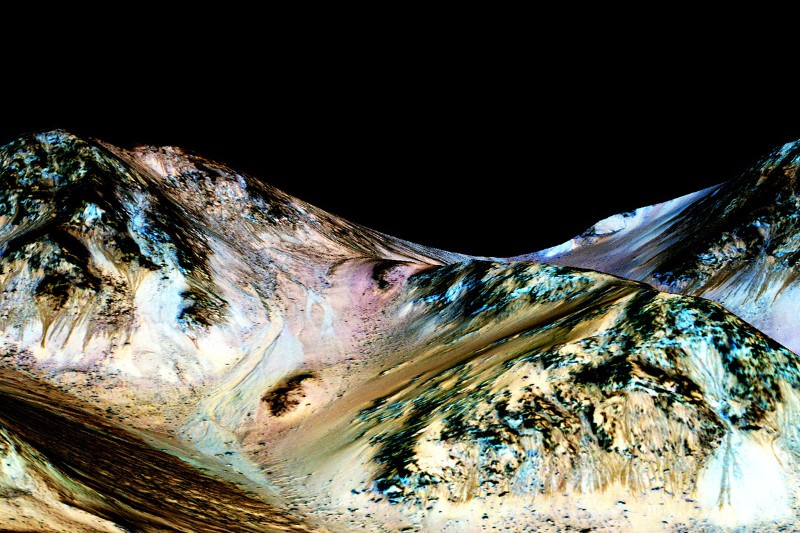
Salty water seen flowing on Mars, not far from Curiosity rover


Salty water seen flowing on Mars, not far from Curiosity rover

The dark streaks in this picture may be signs of salty water (Image: JPL/NASA)


NASA’s Mars Reconnaissance Orbiter has captured the strongest
evidence yet that salty liquid water flows on the planet’s surface
during warm seasons.


Whether or not these salty flows could sustain life depends on how salty they are, says Lujendra Ojha
of the Georgia Institute of Technology in Atlanta, who has reported the
findings, along with his colleagues. “If the water is completely
saturated with perchlorates [hydrated salts], then life as we know it on
Earth wouldn’t be able to survive in that sort of concentrated water,”
he says. “But if the water only has a tiny percentage of perchlorates in
it, then I think we should be fine.


Recurring slope lineae – dark streaks that appear, get longer, and fade in each Martian year – have long been thought to represent signs of flowing water. Now that idea has been backed up by data from the Orbiter’s onboard spectrometer, named CRISM, which analyses reflected sunlight to detect patterns that indicate what minerals are present on the surface.


Salts can absorb water from the atmosphere and lower the freezing
point of water, making it possible for liquid water to exist even in the
cold Martian climate. Spectral data from four locations with recurrent
slope lineae reveal the presence of hydrated salts, which are most
likely to be magnesium perchlorate, magnesium chlorate and sodium
perchlorate.

Saturday, September 26, 2015

NASA to Announce Mars Mystery Solved | NASA

NASA to Announce Mars Mystery Solved | NASA

 NASA will detail a major science finding from the agency’s ongoing
exploration of Mars during a news briefing at 11:30 a.m. EDT on Monday,
Sept. 28 at the James Webb Auditorium at NASA Headquarters in
Washington. The event will be broadcast live on NASA Television and the
agency's website.

Wednesday, August 26, 2015

Abraham Loeb: From cosmic origins to our galaxy’s fate | Astronomy.com

Abraham Loeb: From cosmic origins to our galaxy’s fate | Astronomy.com

 This theoretical physicist and philosophical thinker discusses
diversity, the first stars, the future of cosmology, the way physics
makes progress, and more.

Friday, July 24, 2015

Earth-like alien world looms into view through Kepler telescope - New Scientist

Earth-like alien world looms into view through Kepler telescope - New Scientist


Meet Kepler 452b, Earth’s new alien cousin. This rocky planet is the first alien world we’ve seen that circles a sun-like star at a distance that should allow liquid water to exist on its surface.


The planet came to light after a first pass through the full data set
collected during the NASA Kepler telescope’s four-year run. The
analysis also yielded about a dozen other candidate worlds close to the
size of Earth in the habitable zone around their stars.


Kepler’s original mission has ended,
so the new discoveries come not from new data but from
ever-more-thorough analyses of the existing data. Small Earth-like
planets have proved the hardest to tease out. “We’re treading through
the weeds looking for these tiny stones,” says Natalie Batalha from the NASA Ames Research Center in California.


The new search adds more than 500 planets to the roughly 4000 planet candidates the Kepler team has already announced, of which about a quarter of have already been confirmed through follow-up studies.


But the newest confirmed planet, 452b, is in an Earth-like class by
itself. “Today the Earth is a little less lonely, because there’s a new
kid on the block,” says Jon Jenkins,
also at NASA Ames. The new planet was confirmed when team members
calculated that there was a less than 1 per cent chance that a pair of
eclipsing binaries or a background transiting planet could be polluting
the signal.

Monday, June 01, 2015

Origins of Life On Earth & Beyond --"From Matter to Living Biology" (Weekend Feature)

Origins of Life On Earth & Beyond --"From Matter to Living Biology" (Weekend Feature)

 Such primitive cells, or protocells (iamge below), would have been much
simpler than any of today's modern cells, which have an organization
based upon the "central dogma" of biology: DNA, containing a cell's
genetic blueprint in a string of the nucleotide bases A, T, G, and C, is
transcribed into RNA, and then factories called ribosomes translate the
RNA into the sequences of twenty amino acids that make up proteins.
These proteins run almost all of the operations of cells, from bacteria
to humans: moving, metabolizing food, disposing of waste, speeding up
and slowing down the chemical reactions that copy our genes...............